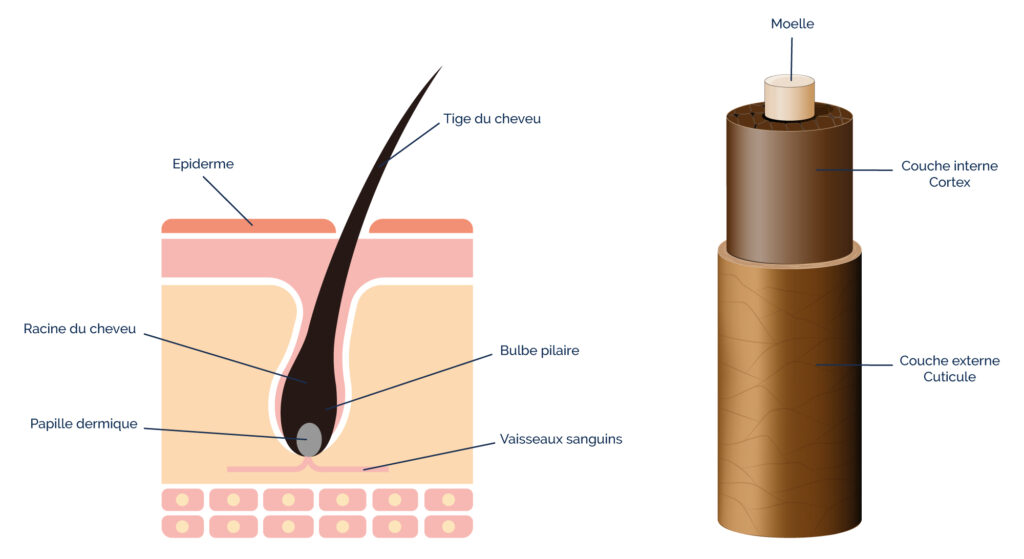
A hair consists of a shaft that extends from the scalp and a portion located beneath the skin: the hair follicle, which includes the papilla and the bulb.
The dermal papilla is a key part of the pilosebaceous follicle, as it contains the stem cells responsible for hair regeneration. The rapid division of these cells drives the hair growth cycle.
The bulb is the structure where stem cells differentiate, migrate toward the surface, and then transform into keratinocytes to form the hair shaft.
It also contains melanocytes that produce melanin, which is responsible for hair pigmentation.
There is also a cone-shaped structure, called the “dermal papilla,” which redistributes blood and nutrients within the bulb.
The sebaceous gland produces sebum, which forms a lipid film that prevents the hair from drying out.
The pilosebaceous follicle is anchored to the dermis and the bulb region by a small muscle (the arrector pili muscle). This muscle is responsible for causing our hair to stand on end under certain specific circumstances.
The hair shaft consists of three parts:
– the outer layer, or cuticle,
– the middle layer, or cortex,
– the inner layer, called the medulla.
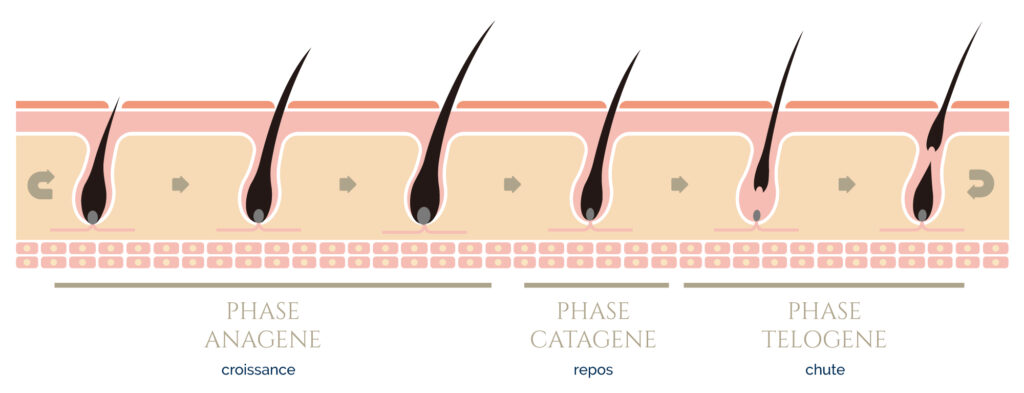
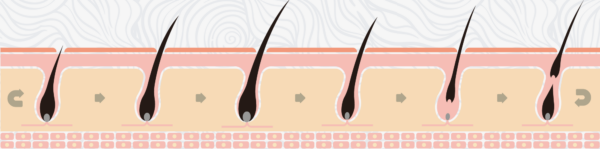
The 3 Phases of Hair Growth:
Anagen: The active growth phase of the hair. It generally lasts 3 years, with growth of about 1.2 cm per month, or 15 cm per year. This phase accounts for about 85% of the hair.
Catagen: The regression phase. This is the period of follicular inactivity; cell division at the root stops, as does hair growth. During this phase, contact between the dermal papilla and the epithelial portion of the follicle is severed. This phase lasts about 3 weeks and affects only 1% of the hair (or 20 to 60 hairs per day).
Telogen: The resting phase. It is during this period that hair shedding occurs. The hair bulb lies just beneath the surface of the scalp and is pushed out by the next hair in the anagen phase. The telogen phase lasts 3 months and affects about 15% of the follicles.
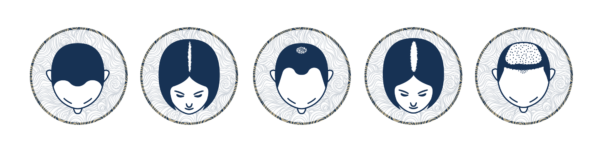
We should therefore have hair until the end of our lives. However, for hormonal, genetic, or psychological reasons, the hair growth cycle can accelerate, become disrupted, and lead to hair loss that occurs more rapidly than expected.
The hair growth cycle lasts an average of 3 years for men and can last up to 7 years for women. Our hair follicles are programmed to complete 25 to 30 hair growth cycles, each lasting 3 to 5 years, over the course of a lifetime.
We should therefore have hair until the end of our lives. However, for hormonal, genetic, or psychological reasons, the hair growth cycle can accelerate, become disrupted, and lead to hair loss that occurs more rapidly than expected.
Excessive hair loss is therefore defined as losing more than 100–150 hairs per day.
The HAROJ center offers treatments and FUE hair transplants to minimize the effects of a disrupted hair growth cycle.

Résidence Charles X
2 Rue Sainte-Catherine
68100 Mulhouse